


Claire Carusillo’s book about a fictional character named Claire Carusillo was one of those books I read and instantly knew it was going to be on Debutiful’s Most Anticipated List. The Responsible Party is just one of those books I stumble over explaining and say, “You know what? Just read it blindly.”
Carusillo grabs you from the jump and takes you on a twisty journey.
[A plug: Debutiful’s FREE Short Story Contest is taking submissions through November 13th. It’s judged by Jared Lemus and Mariah Rigg. Pine State Publicity / Pine State Literary + Mountain Words Fest are graciously sponsoring.]
She was one of the first authors I invited onto the podcast way back in March 2026, when I first received her book. Our conversation covers everything from how only one publisher offered to buy it to why she and her partner opened a bookstore/skateshop in a dusty town outside of Salt Lake City after living in NYC for years.
Apple | Spotify
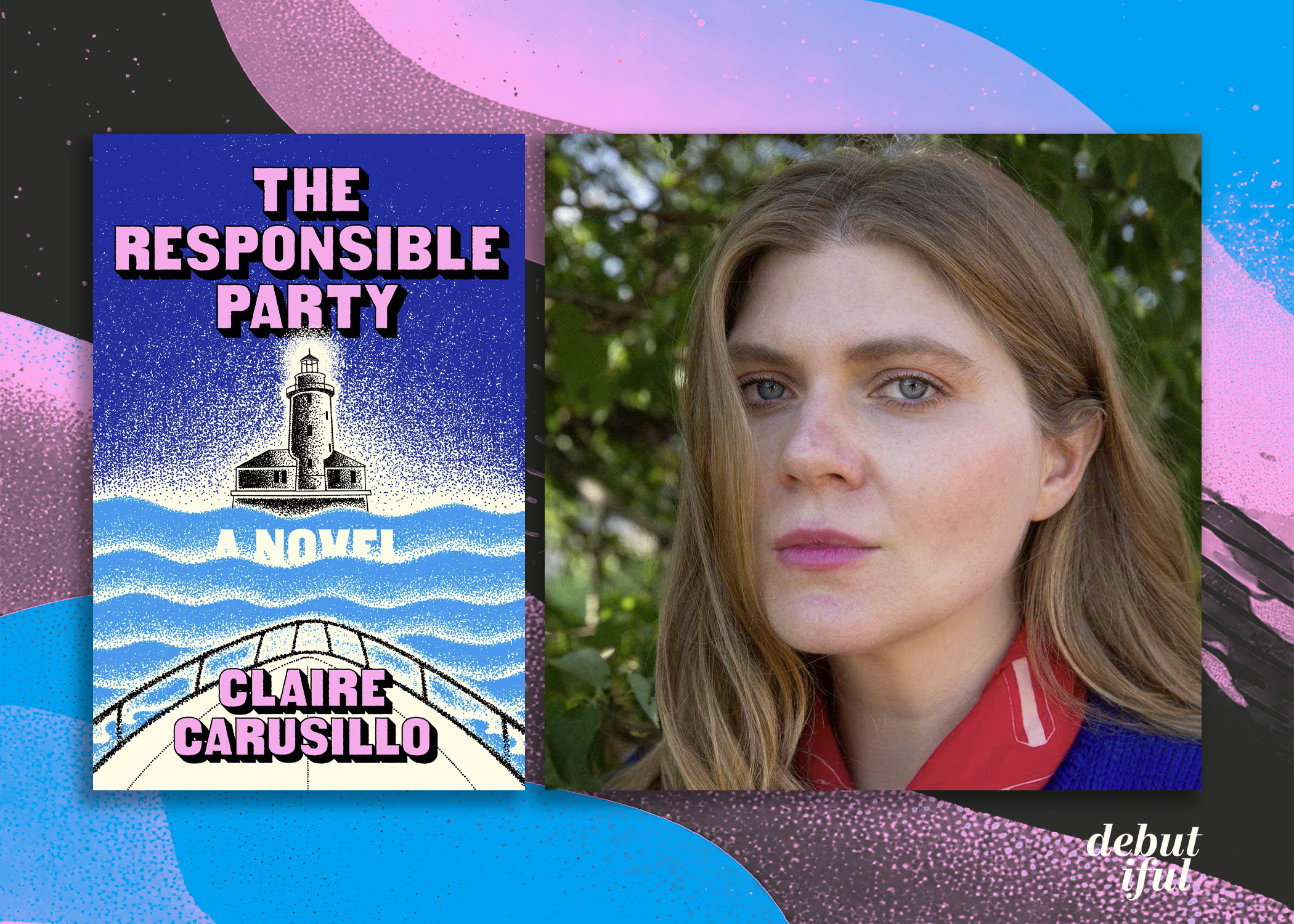
Adam Vitcavage: What’s your unofficial bio? Who are you outside of this crazy debut world?
Claire Carusillo: My name is Claire. I live in Utah in a town called Midway, about 45 minutes outside of Salt Lake City. I did not grow up here. I grew up in suburban Chicagoland, but I find a real draw to being surrounded by natural beauty, even if I’m not always, or even usually, outdoor recreating.
As of probably eight weeks ago, I opened a bookstore, skateboard shop, and coffee bar in this little town. It’s called Storyboard, and that has been consuming me for the most part. So when you’re asking what I’m doing outside of reading and writing, I guess I’m doing this thing, but it has a little bit to do with reading and writing, too.
Adam Vitcavage: Amazing. We’ll come back to Storyboard. That excites me very much. I love talking about bookstores, and I think what you’re doing, though I don’t know a lot about it yet, is the kind of thing that will make bookstores thrive. Having coffee and a skate shop gives people another reason to come in.
Claire Carusillo: We’re hoping. It’s a little bit of an impetus to get people in the door. And if we’re getting people who are involved in another discipline that has historically hung out in a third space, why not combine them and see what we can get cooking?
Adam Vitcavage: Exactly. We’ll come back to that. You grew up in the Chicagoland area. Did you skate? Was that part of your life?
Claire Carusillo: I didn’t learn how to skateboard until I was 30 years old. My boyfriend, my partner who runs the shop with me, is a dyed-in-the-wool skate rat. When we met, he taught me how to skateboard, and a lot of that time my dog was with us, pulling me on a skateboard. So that’s the mode of skating that I’m interested in. You’re not going to see me attempting a gnarly kickflip or anything. I’m just cruising around, and I’m always wearing a helmet and full pads. Got to protect the moneymaker.
Adam Vitcavage: Got to.
Claire Carusillo: Got to.
Adam Vitcavage: I live in Denver, so not Midway, Utah, but similar vibes perhaps. And we are inundated with electric scooters and bikes from some company. It drives me crazy for numerous reasons, but one of them is that people who probably never ride bikes or scooters are riding them without helmets. It’s so dangerous.
Claire Carusillo: Oh my God. I know. I think it’s more dangerous than skateboarding without a helmet.
Adam Vitcavage: Because it’s motorized.
Claire Carusillo: Totally. It’s really wild. I have an e-bike because I live in a small town and I can take it to the grocery store. I have saddlebags on it, but I’m always strapped in.
Adam Vitcavage: And you’re like a professional biker. You’re doing it right.
Claire Carusillo: Exactly. I’m trying to cede the roadway to pedestrians and do it to the letter of the law.
Adam Vitcavage: You weren’t a skateboarder until you were 30, and you might not even call yourself a skater now, but you are.
Claire Carusillo: I would. Thrasher T-shirts or whatever. But no, I don’t pretend this is the culture that raised me.
Adam Vitcavage: Was writing the culture that raised you? How involved was that in your life growing up?
Claire Carusillo: Our family joke, in some ways, is that I had two older siblings who were naturally gifted academically very early on. Then the third kid came along, which was me, and we always say my parents forgot to teach me how to read. Maybe there was more to it than that. I won’t foist the blame upon them, but my memory of first grade is that they would take me to a janitor’s closet and make me go to remedial reading. I don’t know if it was actually a janitor’s closet, but I did read pretty late. I probably wasn’t reading until I was six and a half.
I wonder if much of my academic or writing life since then has been overcompensating in some way because I felt behind in reading very early on. But I did take to it as a hobby, and even when I was younger and before the iPad of it all, I did notably observe that I liked to read in a way many of my classmates were not necessarily reading. It’s always something that comforted me. You know from reading this book that I’ve never been a good sleeper. I’ve always been afraid of the dark, so having a light near me and a book near me has always been a comfort object.
Adam Vitcavage: You mentioned overcompensating. I feel that way with reading. Debutiful kind of became my life and my personality for a while, and I’m trying to make that a more healthy relationship. The more books I get and feel like I have to read, the more I have to remind myself that I don’t actually have to read all of them.
With writing, I’ve talked to a lot of writers about how it’s a compulsion. You need to write in one way or another. Was writing a compulsion for you leading up to your MFA? Or was it still playful, like maybe this will become a profession and maybe it won’t?
Claire Carusillo: No, I think it was always a compulsion for me. Again, let’s forget about those early years when I could not read or write and was significantly behind my classmates in that sense. But early on, I felt a comfort in confession. Confessing something creates some sort of community, or at least another person saying, I feel this way too. Or, on the flip side, I haven’t felt this way before, and it’s interesting that you observed that and put it in writing.
Very early on, I felt some sort of compulsion to write. It’s not like I was young and writing novels, but I was always on the school paper. My job for a long time out of college, and sometimes to this day, is that I’ve been a writer on the internet. I’ve been a journalist in the classic sense before, but I always feel I write best when I am writing about myself or allowed to put myself observationally into pieces.
Adam Vitcavage: Writing on the internet, doing journalism. When does an MFA come into your mind? Why do it?
Claire Carusillo: I applied for an MFA two years out of college. I had lived in Washington, D.C., working at a political super PAC, I guess that’s what you’d call it. Then I got my first job at a website. I was doing social media, and I really wanted to write more. I had started a newsletter called That Wet Look that was by no means an MFA-quality piece of writing, but it did well for me. It was a way to get away from my day job, or even the pieces I was being assigned as a freelancer outside my day job. It allowed me to write about myself a little more.
I guess I was getting feedback and having a fun time with it, and that made me think I could try for an MFA. The Responsible Party took me ten years to get published from start to finish, so I had also always had an idea of this book I wanted to write knocking around in my head since I was a little kid. Getting some positive feedback on the internet for writing about other things allowed me to take myself more seriously in some way.
Of course, people can write a novel without an MFA. If I had the chance to go and do this again, I’m not sure I would make all of the same decisions that I made. I did love being in that program, but I wonder how the world has changed since 2016, when I started. But yes, getting a little bit of positive feedback allowed me the luxury of taking my writing more seriously.
Adam Vitcavage: That’s funny. I try not to talk about myself on the podcast, but I started writing seriously, in air quotes, for the first time in January.
Claire Carusillo: Of this year?
Adam Vitcavage: Yeah. I never wanted to write fiction. It was not my thing. I wanted to do journalism always. Then life happened and I started doing pop culture journalism and then literature interviews, basically. But then I applied for two workshops that I got into. I think about workshops and wonder who can really afford to apply for these things, but I got into them, and it was helpful to hear outside validation from people. It was like, maybe I’m not terrible at this.
Claire Carusillo: Totally. The MFA conversation is probably something longer than we have time for right now, but I encourage anyone who’s a writer to workshop. That was a transformative experience for me. Before I did my MFA, I think I did three once-a-week workshops at a place called Sackett Street in Brooklyn. That was a total life changer. I probably could have been satisfied doing that kind of workshop for a long time. I really think it makes you a better communicator and makes you see outside yourself. It’s a wonderful thing to get involved in.
Adam Vitcavage: Your MFA was 2016-ish, then? Was that when The Responsible Party started being written?
Claire Carusillo: I think I wrote a couple of short stories before turning in the first couple pages of this novel, probably in my first semester of MFA in 2016. They were kind of concurrent. It’s not like I went into the program for the express purpose of writing this specific novel, but the more feedback I got on it, the more I started thinking about it as a long-term project.
Adam Vitcavage: The Responsible Party is ten years in the making. I like to ask writers: cutting through what media might say or what a publicist might say, how do you clearly pitch The Responsible Party?
Claire Carusillo: It’s tough because it has three timelines. I usually lead, because marketing has led with this, with this old-timey plotline about these ancestors of mine. Sarah Monsey and Fanny Mounsey are my great-great aunt and my great-great grandmother. They endured two shipwrecks in a row in 1914 and 1915. That’s the splashier part of the book, and it is the foundational myth the book rests upon.
But a lot of the other parts of the book, the other two threads, get a little lost in that marketing pitch. Fundamentally, I think this is a book about a mother recounting her childhood in the 1970s to her daughter, who shares the same name as me. It’s based on a true myth about shipwrecks. In the current-day timeline, a narrator named Claire Carusillo gets a knock at the door and discovers that her matrilineal DNA has been found on a body that just washed up in a creek. The cops insinuate that her mother, who is a tough nut to crack, has something to do with it. Via extortion, guilt, and all of that, Claire gets her mother, Kath, to recount some of her childhood, including living with the shipwreck survivors.
The funnest part of the book, I think, which often gets lost, is this plotline in November 1971, where Kath, as a teenager, gets taken in by this aging scion of industry who lives in a lighthouse 400 yards off the coast of Lake Michigan. She goes to a party there and then sort of gets marooned there. In some way, she learns responsibility.
The book is a pun on the centerpiece of the party, the responsible party. But in other ways, it’s also a title about these shipwrecks and who is responsible for what. And also what kind of smaller-level violence these women are doing to each other and to the people around them.
Adam Vitcavage: It’s so interesting when there are multiple timelines. When I’m trying to describe a book for Debutiful, or just to someone on the street, I usually take the highest-level view of it because it’s easy to get in the weeds when you’re recommending a book. A quick one-sentence pitch often does better than trying to overexplain a plot.
Claire Carusillo: Totally. And that’s hard for me to do, the one-sentence thing.
Adam Vitcavage: With your book, I have two big questions, and you can tackle them in any order. Why name the character Claire Carusillo, and why three timelines? How did that unfold?
Claire Carusillo: We can start with the timelines. Maybe that will lead to an answer.
Adam Vitcavage: Perfect. You’re in your MFA. The Responsible Party is starting to become bigger and bigger. What was the first timeline?
Claire Carusillo: The first timeline was a contemporary narrator recounting a true family story about shipwreck survivors in her family. That is a true story, though I’ve taken an enormous amount of liberty. In some ways, I’ve sullied the names of my ancestors by including their real names in this book. But it was a story that haunted me as a child. All these shipwrecks and the fact that perhaps fate is real, and maybe this sort of drowning could be coming for me or my family or my loved ones at any time, because we shared this lineage.
I started referring to it internally as disrespectful historical fiction. I always thought it was funny to have a contemporary narrator who hasn’t done a lick of research recount a family legend. I don’t know how much interest people have in the truth of this story, but there’s a lot of stuff on the internet that you can find out about these women that doesn’t happen in my book. These are verifiable facts that, if the narrator had done a quick Google, she might have been able to figure out. And yet I wanted it to be colloquial.
Sometimes I compare it to the tone of Drunk History. The show hasn’t been on in a decade, but I always thought it was hilarious the way people were retelling a story they pretty much knew the gist of in such a casual way. That was the tonal foundation and mythological foundation, if you will, of the book.
Then another ripped-from-the-headlines-of-my-own-life situation, to a lesser degree, is that I always knew a story from my mom, whose name is not Kath. It’s confusing because the character in the book is named Claire, but I gave my mother character a different name. The dedication is to my real mom, Suzanne, and the first thing you read in the book is that it’s dedicated to Suzanne, whose name is not Kath.
My mom would anecdotally mention, when we drove from the suburbs into Chicago, that we passed this lighthouse 400 yards off the coast. When my mom was in her 30s, she had a coworker who lived in that lighthouse and rented it from the Coast Guard for a dollar a month, and she would go party there. Again, I have totally sullied and corrupted that story of my mother’s. I made the mother character a teenager. All sorts of debaucherous things are happening in this lighthouse that aren’t true.
I always had these two timelines going back and forth. It probably wasn’t until five years into writing the book, when my agent Monika Woods suggested that the narrator needed a name and something to do. I think Monika suggested that I just name her Claire, and I was like, yeah, that works. It would seem disingenuous to me if I gave this narrator any other name.
I always knew there would be a murder mystery involved, where a disinterested narrator finds herself getting involved in this. I also think it’s funny to have a murder mystery where the central murder issue is solved halfway through the book, and we turn to a more compelling mystery from there. That is how it evolved over the course of the eight years it took me to get a book deal.
The character being named Claire felt right. I named the mother character something different out of respect for my living mother. I kept the names of Fanny and Sarah out of respect for their legacy. But Claire felt like I was telling this almost-true story, and it wouldn’t work for me if anybody else were telling it. Even if my circumstances are totally different from what I wrote into the book, I was looking for what I call the oomph of the truth, the emotional thrust of the truth. That remained more truthful if I gave the narrator my own name.
Adam Vitcavage: You started your MFA in 2016, and now the book is being published in 2026. What’s the path after your MFA? When do you finally get a draft that’s draftable? When do you talk to Monika Woods, who runs Triangle House?
Claire Carusillo: I had a different agent before Monika. I probably got her within six months of finishing my MFA. We were connected through a mutual friend. We worked together for maybe two years, and it ended up not working out. There was also quite a bit of turmoil going on in my life at that point.
Another friend introduced me to Monika Woods, who I had known socially a little bit, which is part of the luck of living in New York. Monika sort of rescued this book for me, no pun intended. She very quickly agreed to help me, but she let me know how much work we still had left to do. I think I wrote one more draft for her.
One of the things she had me do, which I’ll forever be grateful for, is create a timeline where we see all three timelines on a spreadsheet. Every single beat, every single bit of dialogue, plotted sequentially next to each other in the three different timelines. In that way, I was able to have all three timelines mirror one another because it’s three generations of the same family. And because the plot became so complicated, you learn things about the original timeline in the 1970s plotline and back and forth. There is a mystery to solving this.
The fact that she had me do so much work ahead of time, plotting it out like that, means I basically have an answer for any plot hole that might come up. I do think the plotting of this is airtight. Monika and I worked together for at least another two years. We went out on submission. Only Holt said yes, and that took about six months. Holt’s condition on publishing it was that I had to excise a 50-page plotline from the book. From signing a book deal to publication, that was another full two years, or something like 23 months. This was not a miraculous story of a wunderkind getting it right.
Adam Vitcavage: I want to go back to agent number one. I don’t need any specifics, but did you have a draft then?
Claire Carusillo: Yeah. My final MFA thesis was a draft of this book, and it was much shorter. It was probably 200 pages, and now I think we’re at 336 or something. But using that, I was able to do it. Again, you don’t need to go through an MFA program to have a draft of a book that an agent will look at.
Adam Vitcavage: Cool. I just wanted to clarify.
Claire Carusillo: I think it’s been a really circuitous path for me. There were a lot of times when this just wasn’t happening, and I kept trying to make it happen. I think I knew somewhere that this could happen at some point. That’s the only reason it exists.
Adam Vitcavage: You mentioned only Holt made an offer and you had to cut 50 pages. Now, from an outsider’s perspective, someone who’s semi-inside the book world, the book is being talked about. People are in it. So do you think that if those 50 pages that eventually were cut weren’t in it, there might have been more offers? Do you think about things like this, or is it not even healthy to think about?
Claire Carusillo: It’s been really interesting. I worked in media for the entire decade that I was writing this book. This is not me tooting my horn about work ethic. This is just how it has to go when you have a job. For many years, I was a person who would wake up at 4 a.m. several days a week and get writing done before my job. Some of that time, I also didn’t have a job, to be real. But often I did have some sort of internet writing job.
It was very hard for me to be a person who wrote for a living and had staff jobs or good freelance jobs, and then in this other arena that wasn’t celebrity blogging or beauty writing, to be a total rookie. These are two totally different realms of writing. I did feel hurt and shocked that I wasn’t being taken seriously at all as a fiction writer, which I had gone to school for.
I’ve heard this book called maximalist, and that’s not an aesthetic I aim for, but I do believe in letting people cook and seeing what happens. I don’t think the version of the book that had the extra 50-page plotline is a better book. That’s a testament to my editor Emily at Holt. But I do think there’s room for bizarre plotlines, bizarre plotting, and bizarre cadence that I don’t think a first-time author can fully get away with, maybe.
That said, I do feel unfettered in some way in this book. I was allowed to be a little wild and keep talking constantly, even if it had nothing to do with the plot. I’m forever grateful to my editor for that. But yes, I do think a lot of it has to do with risk in the publishing industry. We’ll see. I have a bookstore, and I haven’t sold a book yet. I have no idea how this book is going to do.
But it’s been interesting now that I’m receiving two or three pieces of institutional praise. I’m like, oh, damn. Maybe I had this all along. I don’t know. It’s definitely a very overwhelming time for me. I got written up in the Times yesterday, and I cried for an hour after that happened because the first time I ever read book reviews, my parents got the Sunday New York Times. That was so overwhelming for me. I didn’t think that was something that could happen to me. That’s not to say, oh, I’m just some kid out of nowhere. I obviously have connections other places and an immense amount of privilege. But it’s been a really interesting time because I couldn’t get this book published for so long, and two days from publishing, things are going better than I expected.
Adam Vitcavage: I won’t belabor this point, but I think the more people are in the industry in some way, shape, or form, either writing freelance outside literature but with an MFA or without an MFA, or writing for literary magazines, it makes it that much harder because you know what’s happening. It’s like, why did this happen for this person but not me? Not that jealousy is involved.
Claire Carusillo: No, it is.
Adam Vitcavage: It is. But it’s like, when you know this person got their Times review two weeks ahead of time, you’re wondering, where’s mine?
Claire Carusillo: Yeah. I learn things every day. The things we read into about publishing time. It was definitely hard for me. I graduated from my MFA in 2019, and I have seen classmates lap me in writing books. There are so many people who have written beautiful books that I’m so proud of, and it’s amazing to see their projects go from workshop to a published book. But it was always tough for me. I did always think I would eventually get to this place, but it was never happening fast enough.
Adam Vitcavage: I don’t want to take up too much of your time because you have to open Storyboard, your skate shop. One question on this, and then I’ll ask my final question. You love books, and your partner loves skateboards. Was that it? Is that how this came to be?
Claire Carusillo: He’s a writer and a reader too, and I guess I would consider myself a skater in some ways now since we’ve been together. We both moved from New York. Moving anywhere from somewhere where you have community or places to convene, a third space, is daunting when you’re moving somewhere that’s more rural. Where am I going to have community?
I wanted to be in an environment of mountains and nature and streams, but in some ways we wanted to create a cultural hub, even as tiny as this place is. We think that happens at bookstores. We think that happens at skate shops. We think that happens at coffee shops. I really can’t think of three things that go together as well, and that people spend as much time milling about in.
Again, we’ve only been open for eight weeks, but it has been pretty remarkable. Put aside sales. Put aside the amount of money that we owe people. It has been remarkable every day to see people show up. The conversations I have with people, people I had no idea I had shared affinity with, whether we’re talking about books or skating or coffee or not, have been really cool. In this small town where I did not grow up LDS, like many of the people here, it’s interesting to find out that wherever you go, if you create a space, your people will find you.
Adam Vitcavage: I agree 100%. Since you’re a brilliant writer, but also a bookstore owner who reads a lot, what are some reading recommendations you can drop on our listeners?
Claire Carusillo: The one that I just looked at on my bookshelf that blew my mind is The Sisters by Jonas Hassen Khemiri. Our barista Avery, who’s the only other person who works at Storyboard, is a big reader too, and she recommended it to me. That book was kind of a mind blower. It’s so thick, and any time someone asked what I was reading and what it was about, I was like, it’s just about the sisters. It really is just about some sisters hanging out.
The interesting thing to me was that it is fiction, probably inspired by real-life events, told by a narrator who shares the same name as the writer. It was very inspiring to me, even though my book was pretty much sealed up and done by the time I picked it up, to see someone do it at such an expert level and to enamor me with this book.
I just read The Housewives Underground by Kaitlyn Tiffany, who is a friend. She wrote an incredible book. I’m going to butcher the first title, but it was Everything I Need I Get from You, which is about how fangirls built the internet. Her follow-up nonfiction book, The Housewives Underground, is about the women who formed a network over letters and investigated the official findings of the Warren Report in the wake of the JFK assassination. That’s a mind-blowing book. She did so much deep research, and yet it comes off as so readable.
I also just read Upward Bound by Woody Brown, who is nonverbal autistic. That was such a fascinating, heartbreaking read to me. I read it really quickly. Because I live in Midway, Utah, home of Ballerina Farm, I did just read Yesteryear. I’m not necessarily sure I’d recommend it in a general sense, but the number of conversations I’ve had about this book in my little bookshop has been totally illuminating and incredible. No one will ever stop talking to me about it, for some reason.
I’ve started reading Lonesome Dove, but I actually took a break last night to read Sunrise by Téa Obreht. I’m about 150 pages into Lonesome Dove, and all that’s happened is cowboys clowning on each other. Nothing’s happened yet. But I like it. It’s funny to hear these guys razz one another.